
They say there is nothing new in football. It’s a classic trope; Almost everything you can think of has been done before by some other team throughout the NFL’s 100+ years of evolution. From implementing the first spread option offense to using a dime package as a base defense, it’s all been tried and tested in some form or another. Legendary teams have come and gone, and the game has been irreversibly changed time and time again. The solutions to modern issues lie in the past just as much as they lie in the future.
They say there is nothing new in football.
They’re correct.
To solve their offensive woes, the Buffalo Bills should turn back the clock, and do something no-one has succeeded in doing since their predecessors, 30 years ago. Return to the K-Gun.
What Is The K-Gun?

In the 1990s, the Buffalo Bills devised the famed ‘K-Gun’ offense, taking lead in a revolution of how we understood NFL football. For the Bills, the K-Gun was birthed from the ashes of the 1988 AFC Championship. The Cincinnati Bengals had beaten Buffalo with their own no-huddle offense, and the team were inspired. That off-season, the Bills got to work.
The ‘Run and Shoot’
Now, Cincinnati were the trigger for this change in Buffalo, but not the source material. For that, we owe credit to the ‘Run and Shoot’, made successful in the NFL by Warren Moon’s Houston Oilers. They took the league by storm with their ‘backyard football’ approach, where receivers read the defense alongside the QB and found soft spots in the zone consistently.
The point of ‘The Shoot’ was that, with an option on every play, the coverage could never be 100% correct. Receivers always had the ability to simply be somewhere else. If they read cornerbacks playing off coverage, they can choose comeback routes. Press coverage on the line of scrimmage without safety help? They can get behind. Make a living finding soft spots in the zone. We’ve heard it said before: ‘Just Get Open’. The overarching concept was to trust the intelligence of the receivers, and the QB to find them when they got open.
But, as we know, nothing is new in football.
The Oilers brought the Shoot to the NFL, but they didn’t invent it either. The first instance of it being used in pro football was with none other than the USFL’s Houston Gamblers. The Gamblers’ quarterback? Jim Kelly, fresh off his spurning of the Bills selecting him 14th overall. He dismantled the USFL, alongside Darrel ‘Mouse’ Davis, the Shoot’s creator.

Funny how these things come around. If not for the 1984 USFL season, the Oilers never institute the method, and the Bengals never lean on no-huddle in 1988. The Buffalo Bills don’t get that wake-up call which turned a conventional NFL team into a defining force of their era.
One thing is for certain: Without his USFL experience with Run and Shoot, we never see Jim Kelly bring the K-Gun to life.
A Football Revolution
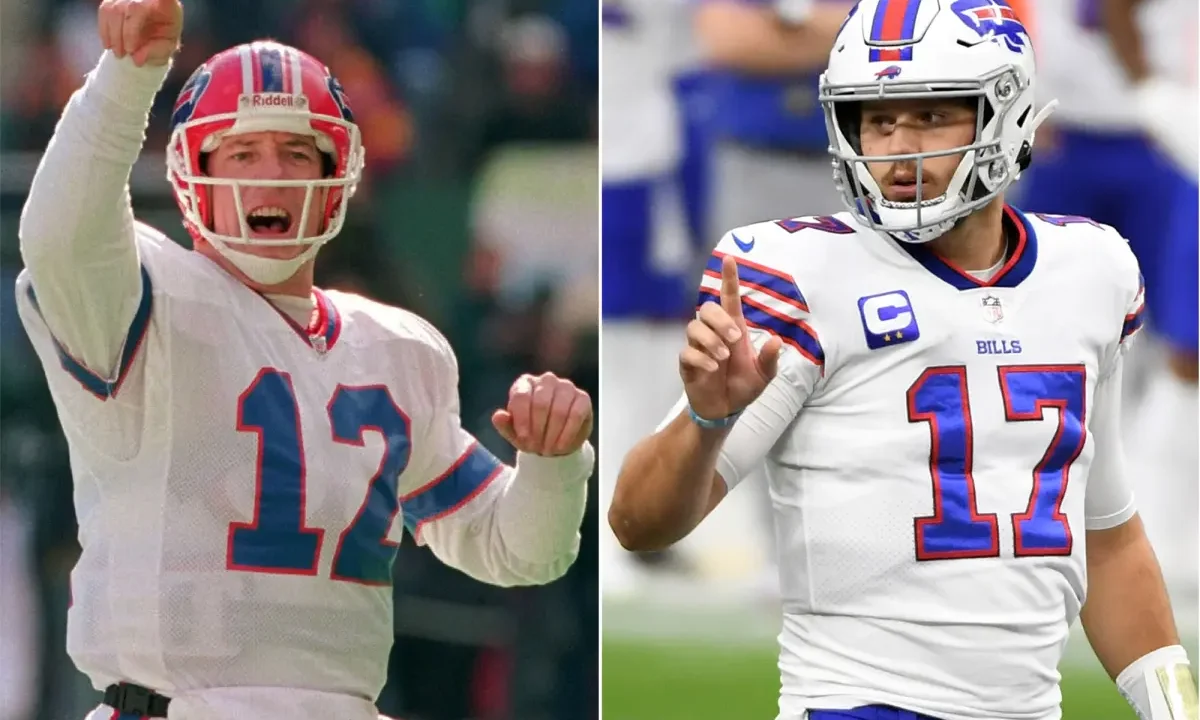
So it began. Head coach Marv Levy, offensive coordinator Ted Marchibroda, and Jim Kelly himself engineered the new style of offense, with Kelly calling his own plays. But what made it different from its Run and Shoot origins?
For starters, a seemingly simple matter of formation and personnel groupings. The Shoot had typically been played with four receivers, two wideouts and two slots, to space the defense and open gaps for them to read and run their options. Kelly loved this pass-happy approach in the USFL, but Marv Levy knew that in the NFL they needed more balance. They needed to run the ball. Marv wanted to find a way to keep the defense on the back foot in the passing game, but integrate a talented running back by the name of Thurman Thomas into the offense.
Keeping a healthy run game was critical to Levy’s philosophy. The question could have plagued him for an eternity. On nearly any roster in the NFL, it couldn’t have been done. The answer was only simple because they already had the right man for the job. A tight end by the name of Keith McKeller.
Meet Keith

Nicknamed ‘Killer’ — the origins of the ‘K’ in K-Gun — McKeller was a 6’6” TE who has surprising speed for his 245lb frame. He could run routes with the best of receivers, and was unsuspecting yet effective as a blocker in pass protection or run blocking. It was on his back that the foundation for the new K-Gun was laid. Alongside Thurman Thomas, Killer was the key to the offense’s success.
Why The K-Gun Worked
It debuted in 1990, against the Philadelphia Eagles. Jim Kelly opened the game by going 8 of 8 for 3 TDs and 229 yards in one quarter; The K-Gun was born.
Defenses couldn’t remotely predict the play based on personnel. If they broadcast one look, they couldn’t sub out of it when the Bills had the leverage they wanted. It resulted in a relentless attack which kept defensive coordinators reeling. Buffalo couldn’t be counted out of any deficit, with their innate ability to score quickly and consistently. There was no such thing as garbage time.
Short, high-percentage passes were abundant, and kept the field open for traditional rushes and deep pass attempts. ‘Football IQ’ was a key factor for offensive personnel, as receivers had to be able to communicate effectively with the QB on audibles without a huddle. Buffalo had to be able to run a wide variety of plays form those audibles, but it was highly effective. The ability for the running back to be effective as a receiver in the short passing game was a valuable tool, but Keith McKeller was the man who kept defenses guessing.

But, despite McKeller’s importance, the success of the system was never about elite production from the TE. It was about the indecision that having a RB and a TE who could play receiver from their positions forced upon the defense. McKeller never saw elite production in a season, but his presence was invaluable.
That lone historic iteration of the K-Gun died when McKeller retired ahead of the 1994 season. Though teams have tried comparable concepts over the years, no team has truly brought the K-Gun back since the Bills rode it to four consecutive Super Bowl appearances.
Why Can The Buffalo Bills Do It Now?
You may ask: Why do we believe the Buffalo Bills can pull off the K-Gun, when 30 years of NFL teams have failed to replicate it’s success?
It’s a valid question, but one with a seemingly obvious answer. Personnel.

Tight end Dalton Kincaid has been a hit in his rookie season thus far, with his growing role and increased target share opening up the offense and providing that safety valve Josh Allen has so desperately needed since the loss of Cole Beasley. For this offense, a 6’4”, 240lb tight end who can run and catch like a receiver may just be the answer. Marv Levy thought the same thing in 1998.
“I feel like when we were going a little bit more up-tempo, we were moving the ball a little better. That might be something, but just get everyone together, get some high energy, and just move the ball.”
Dalton Kincaid Postgame following the loss to the Bengals Per Matt Parrino/NYUpstate
At running back, James Cook offers Thurman Thomas-level versatility out of the backfield, as well as being our best traditional rusher. That versatility is underutilized. By giving him more yards in the air, particularly in those short-yardage situations, he can contribute in an aggressive way in line with the philosophy of the offense.
Buffalo has a solid receiver in Gabe Davis who can block out of the slot when needed, and a highly intelligent WR1 who can help read defenses pre-snap and ‘get open’. If Khalil Shakir continues to develop as he has for much of this season, talent won’t be the thing holding them back. The Bills could have a modernized K-Gun ready as soon as next week.
Buffalo have excelled in 11-personnel (1RB, 1TE, 3WR) for a long time. Getting the defense they want out on the field and keeping them off balance would let them thrive in that grouping.
Realistic Expectations
But let’s not be too optimistic here. It would be ludicrous to expect the team to implement a wholesale scheme change in the middle of the season. Shifts and adjustments occur, but to truly recreate that fabled K-Gun they would need the offseason. They do, however, have everything they need to make this work situationally. It’s something they should more liberally consider to be ‘situationally necessary’.

Perhaps most importantly, Buffalo wouldn’t be locked into that hurry-up style of offense. The Bills can get away from the concept entirely when not seeing success, or in clock-management scenarios with a lead. Nothing would be stopping them from using their typical NFL offense, and getting more comfortable outside the huddle would only benefit this team.
When Dawson Knox returns from the injured reserve, his impact would be significant, but in traditional offensive looks. The keys to the TE1 role should belong to Dalton Kincaid for the remainder of the season.
Why Is It Right For The Buffalo Bills?
The Bills haven’t just been good in various personnel groupings. To know if this revisited K-Gun works for them, we’d have to see the Bills in a hurry-up offense. Good news: This team excels when playing up-tempo. We saw it a great deal against the Tampa Bay Buccaneers in Week 8, before Buffalo ran the clock to preserve their large lead.
It wasn’t just against the Buccaneers that this team thrived when working at speed. Consistently, the Bills have come to life late in close games. Their biggest leads have all come from early and aggressive action that the defenses they face cannot recover from.
When they stop, and start to overthink, things break down. There may have been numerous execution problems over the course of this season, but trust in the players to make the next play is priceless. It can be argued that Josh Allen holds as much blame as Ken Dorsey for the inconsistencies in this offense. When they fail in no-huddle, it has been missed throws or miscommunication that cost us the drive — Sometimes the game.

They opened strong against the Cincinnati Bengals last week, but got away from that up-tempo offense shortly after and didn’t find their groove until they leant on it once more. It was too late, as Cincinnati sent Buffalo packing under the lights.
In that 1988 AFC Championship game, the Bengals handed the Bills a defeat that stuck with them, and played midwife to the birth of an offensive revelation. The K-Gun came along and changed the way we see NFL offense.
Remember: There is nothing new in football.
Featured Image Credit: AP, Getty Images